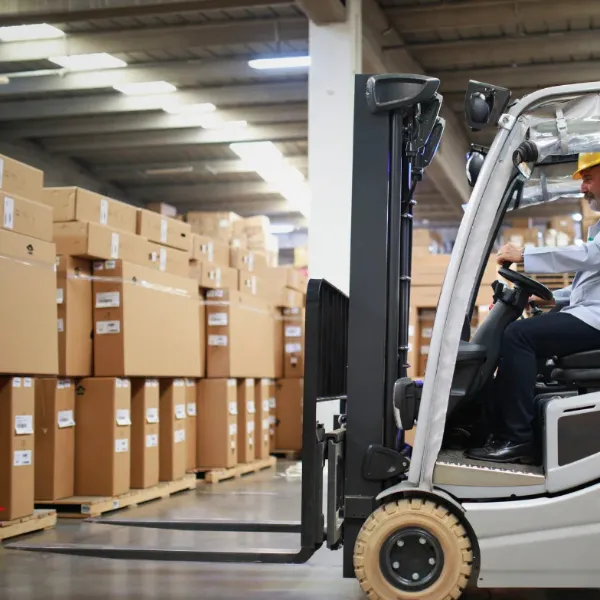
Choosing the best forklift spotlights and warning lights for warehouses is a critical decision that directly impacts pedestrian safety and your facility’s OSHA compliance record. In high-traffic environments where audible alarms are easily drowned out, visual cues are the most reliable defense against collisions at blind corners and busy intersections. The wrong lighting solution doesn’t just reduce visibility; it increases the risk of costly accidents, operational shutdowns, and serious workplace injuries.
This guide moves beyond simple product lists to provide a technical framework for making the right choice. We’ll examine the specific use cases for blue spotlights, red zone perimeter lights, and arc lights, and break down key selection criteria like brightness, durability ratings, and OSHA standards. We also cover installation best practices to ensure your new lights deliver maximum safety impact from day one.
Why Forklift Safety Lights Are a Non-Negotiable Warehouse Asset
Visual warning systems are no longer optional; they are the standard for reducing pedestrian collisions and meeting modern warehouse safety mandates.
Mitigating Collision Risks Through Visual Alarms
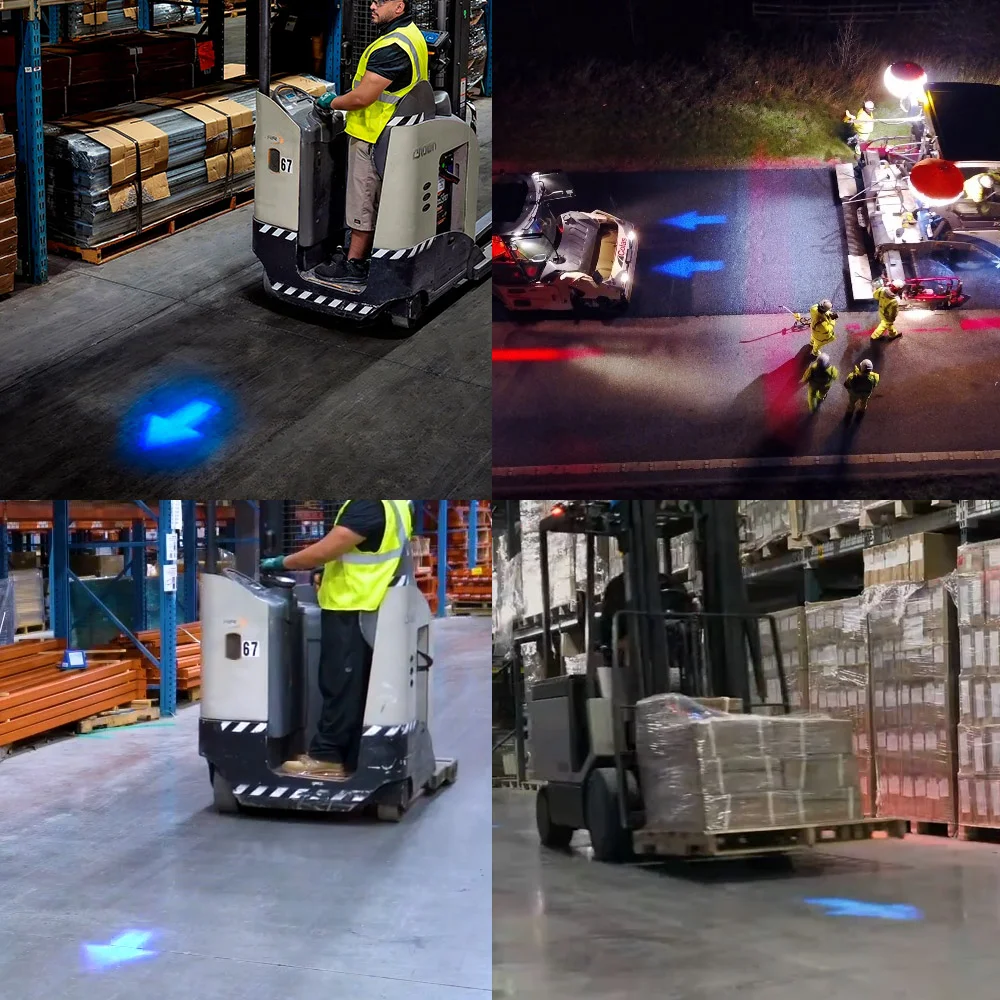
In high-noise industrial environments, standard auditory alarms like beepers and horns are often ineffective. Forklift safety lights provide a clear, unambiguous visual warning that cuts through the noise, significantly reducing the risk of collisions. By projecting bright, moving beams onto the floor, these lights establish distinct safety zones around the equipment. This approach directly addresses key risk factors cited in warehouse accident reduction mandates for 2026, where a proven system for preventing pedestrian-forklift incidents is essential for compliance.
Projecting Clear Directional Cues and Hazard Zones
Effective safety lighting communicates intent without words. High-intensity LED spotlights, often blue or red, are used to project highly visible keep-out perimeters on the ground. Directional arrow projectors go a step further, clearly signaling the forklift’s intended forward or reverse path, which is critical at blind corners and busy intersections. This creates an intuitive, language-neutral warning system that is immediately understandable by diverse workforces.
Ensuring Operational Uptime with Durable, All-Environment Hardware
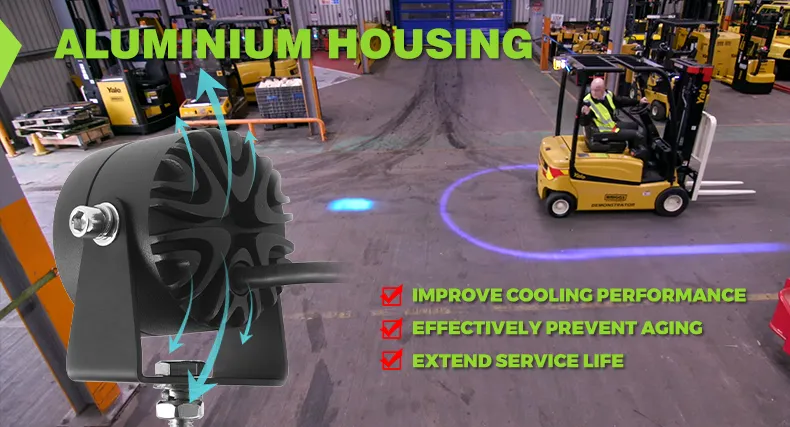
Warehouse equipment must withstand tough conditions. Modern forklift safety lights are built for reliability, featuring IP67-rated enclosures that offer complete protection against dust and temporary water immersion. This durability ensures internal components remain functional in wet, dirty, or high-particulate environments. The use of aluminum alloy housings is standard, providing robust physical protection and, more importantly, efficient heat dissipation. This extends the service life of the high-power LED chips, often rated for over 30,000 hours of operation. A broad 10-80V DC operating voltage range allows for seamless integration across varied forklift fleets, minimizing compatibility issues and simplifying maintenance.
Understanding the Types of Forklift Safety Lights
Different light types serve distinct functions; matching the beam pattern—spot, arrow, or line—to specific facility hazards is crucial for an effective visual warning system.
Forklift safety lights are no longer optional add-ons but essential components for mitigating risk in high-traffic industrial environments. The industry has moved toward LED-based visual systems because they outperform traditional audible alarms, which are often ineffective in noisy warehouses. Three primary types of lights form the core of a modern forklift safety strategy: spotlights, arrow projectors, and perimeter beams.
Spotlights for Pedestrian Proximity Warnings
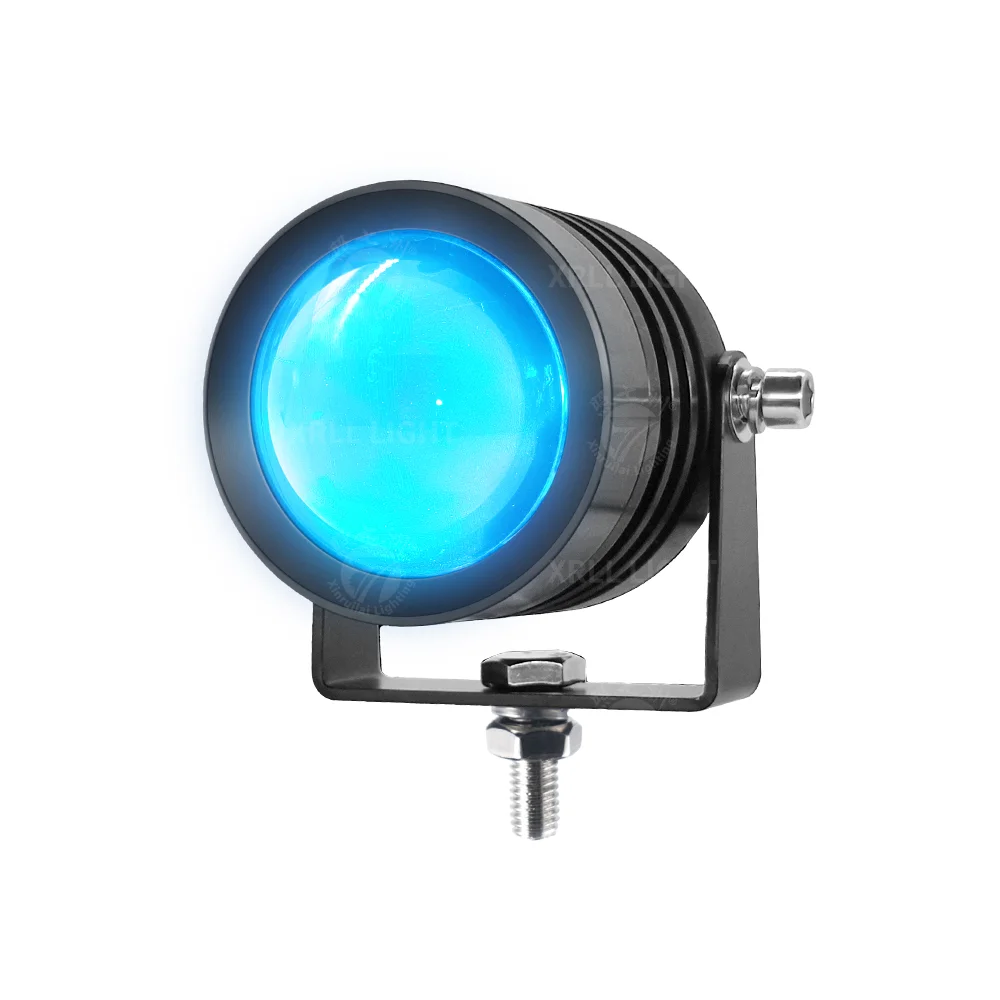
Spotlights project a concentrated, high-contrast beam of light, typically blue or red, onto the floor ahead of or behind the forklift. This beam serves as a clear visual cue for workers, providing an advanced warning of the vehicle’s approach, especially around blind corners and at noisy aisle intersections. It functions as a primary visual alert that supplements traditional backup alarms, projecting a visible dot 10 to 20 feet away to give pedestrians ample time to react and avoid a collision.
Arrow Projectors for Directional Signaling
Arrow projectors eliminate guesswork by displaying a bright, moving arrow on the ground to indicate the forklift’s intended direction of travel, whether forward or in reverse. This reduces ambiguity and the potential for collisions by clearly communicating the machine’s next move. These systems employ high-intensity LED chips, often in a compact 3W unit compatible with a 10-80V DC range, to maintain high visibility across diverse ambient lighting conditions, from dimly lit storage areas to bright loading docks.
Line and Arc Beams for 360-Degree Hazard Zones
Line and arc beams are used to establish a complete visual perimeter, or “keep-out” zone, around the forklift. Side-mounted units project continuous red lines along the vehicle’s flanks, defining a safe lateral boundary for pedestrians. Arc-shaped lights at the front or rear establish a curved hazard perimeter, which is especially useful for showing the swing radius of the forklift during turns. Combining multiple light units allows facilities to create a complete 360-degree visual barrier around the vehicle, effectively communicating a safe distance of 2 to 5 feet for all nearby personnel.
Key Factors for Selecting the Right Forklift Light
Matching the beam pattern, build quality, and electrical specs to your specific environment is critical for maximizing safety and ensuring long-term reliability.
Beam Pattern and Projection Function
The primary function of a forklift safety light is to communicate the vehicle’s presence and intent. Different beam patterns serve distinct operational needs. Spotlights and directional arrows are used for active warnings, while arc and line beams are for establishing static safety perimeters. Choosing the right projection type directly impacts pedestrian awareness and helps prevent collisions in busy or loud environments where audible alarms are insufficient.
- Spotlights: These project a concentrated, high-visibility dot on the floor, typically 15-20 feet ahead of or behind the forklift. This pattern is extremely effective for warning pedestrians at blind corners and aisle intersections that a vehicle is approaching.
- Directional Arrows: Arrow beams provide an unambiguous visual cue of the forklift’s intended travel direction—forward or reverse. This clarity reduces hesitation and misjudgment from nearby workers.
- Arc and Line Beams: These are mounted on the sides to project a clear boundary on the floor, creating a “no-go” or halo zone. Arc lights are ideal for showing the swing radius of the rear end during turns, while straight lines establish a complete perimeter for 360-degree awareness.
Environmental Resistance and Build Quality
A forklift light’s durability is determined by its ability to withstand the dust, moisture, and vibrations common in industrial settings. Look for a minimum Ingress Protection (IP) rating of IP65, which ensures protection against dust and low-pressure water jets. For environments with frequent washdowns or outdoor use, an IP67 or IP68 rating provides superior protection against water immersion.
The housing material is just as critical. A die-cast aluminum alloy housing provides structural integrity and, more importantly, acts as a heat sink. Effective heat dissipation is essential for maintaining stable LED brightness and achieving a long operational lifespan of 30,000 hours or more. Always confirm the light’s specified operating temperature range (e.g., -40°C to 105°C) to ensure it can perform reliably in your facility’s specific conditions, from cold storage to hot factories.
Boost Productivity with Durable LED Work Lights.
Top Forklift Spotlights for High-Traffic Warehouses
Selecting the right forklift spotlight—arrow, spot, or zone—directly addresses specific visibility gaps and pedestrian risks in high-traffic warehouse aisles and loading docks.
Directional Arrow Projectors for Clear Path Communication
Directional arrow projectors provide an unambiguous visual cue for a forklift’s intended path. Instead of a simple dot, these units project a large, high-visibility arrow on the floor, clearly indicating if the machine is moving forward or in reverse. This intuitive signal helps prevent pedestrian confusion and hesitation at intersections. The focused 3W LED beam maintains clarity even in well-lit facilities, supplementing traditional auditory alarms that are often ineffective in noisy industrial environments.
- Voltage Compatibility: Operates on a wide 10-80V DC input, ensuring it can be installed on most electric or internal combustion forklift models without modification.
- Efficient Optics: Utilizes a low-power 3W LED coupled with precision optics to generate a sharp, attention-grabbing signal.
- Durable Housing: Typically built with an aluminum alloy casing for efficient heat dissipation, extending the LED’s operational lifespan.
Blue Spotlights for Pedestrian Hazard Awareness at Intersections
Blue spotlights are the industry standard for early-warning systems, especially around blind corners and when exiting trailers. The unit casts a concentrated, bright blue dot on the floor several feet ahead of or behind the forklift. This moving light enters an intersection before the machine does, giving pedestrians and other vehicle operators crucial advance notice of an approaching hazard. This simple visual cue has proven effective at reducing collisions in fast-paced operations.
- Rugged Construction: Engineered with IP67-rated die-cast aluminum housings to provide complete protection against dust ingress and temporary water submersion.
- Impact Resistance: Built to withstand the constant vibration and occasional impacts common in material handling environments.
Red Zone Side-Lights to Define Pedestrian Exclusion Areas
Red Zone lights address one of the most common causes of forklift-related injuries: foot and crush incidents from the rear-end swing of a turning forklift. These lights are mounted on the sides of the overhead guard and project distinct red lines onto the floor alongside the vehicle. This creates a clear visual “no-go” zone, defining a safe distance that pedestrians must maintain to avoid being struck. The system establishes an intuitive and persistent safety perimeter that moves with the machine.
- Safety Function: Helps prevent common foot injuries and rear-end swing collisions by creating a highly visible keep-out boundary.
- Optical Clarity: Features scratch-resistant, optical-grade polycarbonate lenses that maintain beam sharpness and resist yellowing from UV exposure.
360-Degree Arc Lights for Full Perimeter Safety
Arc lights project a large, semi-circular beam on the floor around the front or rear of the forklift, creating a comprehensive safety perimeter. Unlike a single spot, the arc provides a wider visual warning that is easily seen from multiple angles. This is particularly effective for communicating the forklift’s swing radius during turns in tight spaces. Combining front and rear arc lights can establish a nearly 360-degree safety zone, offering maximum visibility in complex, high-traffic areas.
- Wide Coverage: Generates a large arc of light that clearly defines the hazard zone around the front or rear of the machine.
- Extreme Environment Performance: Engineered for reliable operation in temperatures ranging from -40 °C to 105 °C, making them suitable for freezer applications and hot industrial settings.
Final Recommendation: Prioritizing Aisle Safety
Visual warning systems outperform auditory alarms in noisy industrial settings, directly reducing collisions by creating clear directional and perimeter cues for pedestrians on the floor.
Implementing Visual Cues over Auditory Alarms
In high-noise industrial environments, traditional audible backup alarms become part of the background clutter. Workers experience alarm fatigue, tuning out the very signals meant to protect them. Visual cues cut through this auditory chaos. Instead of relying on a sound that can be muffled or ignored, high-visibility LED projections provide clear, unambiguous warnings. Using spotlights and projected arrows establishes a universal visual language that communicates machine movement and presence without adding to the noise pollution, a proven method for decreasing collision incidents.
Projecting Directional Beams for Pedestrian Awareness
A critical component of this visual strategy is the use of directional projectors. A 3W LED arrow projector, for instance, can be mounted to cast a bright, clear arrow on the floor indicating the forklift’s direction of travel—whether moving forward or in reverse. This simple signal removes all guesswork for nearby pedestrians. It allows them to accurately judge the vehicle’s intended path and speed, especially around blind corners or when exiting trailers. This eliminates the misinterpretation that often leads to close calls and collisions.
Establishing 360-Degree Vehicle Safety Zones
A comprehensive safety plan requires full perimeter awareness. This is achieved by combining multiple light types to create a 360-degree “no-go” zone, or halo, around the vehicle. Forward and rear-mounted blue spotlights warn of the forklift’s approach, while side-mounted red arc or line lights define the unsafe zone to the vehicle’s sides, protecting against rear-end swing injuries. This multi-light configuration creates a standardized visual safety protocol across the entire fleet.
Conclusion
Choosing the right forklift lights and installing them correctly ensures your warehouse operates safely and meets compliance standards. A well-planned lighting strategy protects pedestrians from accidents and extends the operational life of your equipment. These systems are a critical component of any risk management plan in high-traffic environments.
To improve visibility in your facility, evaluate your current forklift fleet’s lighting setup. As a professional forklift safety lighting manufacturer, Best Auto Lamp provides a wide range of certified warning lights designed for warehouses, logistics centers, and industrial sites.
Visit Best Auto Lamp to explore our full catalog of forklift safety lights, or contact our team to get a solution tailored to your operational needs.
Frequently Asked Questions
What are forklift safety lights, and why are they important?
Forklift safety lights are essential visual warning systems, such as LED spotlights or directional arrows, that project onto the floor to create defined safety zones. They are important because they are more effective than traditional auditory alarms for significantly decreasing collision incidents and pedestrian injuries in high-traffic industrial environments and are increasingly driven by OSHA compliance mandates.
What’s the difference between blue spotlights and red zone lights?
Blue spotlights and directional arrow projections are typically used to communicate a forklift’s direction of travel, warning pedestrians of an approaching vehicle. In contrast, other configurations like side-mounted or arc-shaped lights (which create “red zones”) establish a comprehensive 360-degree hazard awareness area around the machine to keep people at a safe distance.
Are LED forklift lights better than halogen lights?
Yes. The market is trending decisively toward LED-based solutions for forklift safety. LEDs are the technology behind modern, effective visual systems like blue spotlights and zone lights, which are proven to reduce accidents and noise pollution compared to older technologies.
How do I ensure the lights I choose are OSHA compliant?
The adoption of visual warning systems is directly driven by growing OSHA compliance mandates. To ensure compliance, choose modern, purpose-built safety lighting systems that are proven to reduce collision incidents and pedestrian injuries, as these features are aligned with OSHA’s goal of enhancing workplace safety.
Can I install forklift safety lights myself?
The provided research focuses on the strategic role of forklift lights as an “essential warehouse infrastructure component” for safety and OSHA compliance. It does not provide details on installation procedures, instead emphasizing the system’s effectiveness in creating visual warnings and defined safety zones.
How often should I maintain or inspect my forklift lights?
While the research does not specify a maintenance schedule, it identifies these lights as an “essential” safety component for preventing injuries and meeting OSHA mandates. This critical role implies that they should be included in regular, routine equipment inspections to ensure they are always functioning correctly.