Understanding how blue light improves forklift safety is the first step in preventing the collisions that cause operational shutdowns and costly OSHA fines. In a busy warehouse, standard audible alarms often get lost in the ambient noise, leaving pedestrians vulnerable at blind corners and crowded intersections. A silent, moving spotlight in a warehouse cuts through the chaos, offering an unmistakable visual cue that a vehicle is approaching before it comes into view.
This guide provides the complete technical standard operating procedure for deploying blue safety lights in your facility. We will break down how the lights function to grab attention, identify the best mounting positions and beam patterns for maximum coverage, and review real-world data on accident reduction. Follow these steps to implement a proven visual warning system that protects your team and your operational uptime.
Introduction: The Pedestrian Safety Problem in Warehouses
Forklift-pedestrian incidents are a predictable outcome of shared industrial spaces, with pedestrians accounting for an alarming 36% of all forklift-related fatalities.
Quantifying the Risk: Forklift-Pedestrian Accident Data
The data reveals a severe and persistent risk profile. More than one in every ten forklifts is involved in an accident annually, and a critical 36% of all forklift-related deaths involve a pedestrian on the floor. This problem is compounded by industry-wide safety metrics; warehouses report 5.5 injury cases per 100 employees, more than double the 2.7 rate for all private industries. This isn’t a random operational hazard but a systemic safety failure demanding direct intervention.
Identifying High-Risk Operational Zones
Certain areas consistently emerge as incident hotspots. Loading docks are statistically the most dangerous, responsible for 25% of all warehouse accidents. The risk density here is extreme, with an estimated 600 near-misses for every single reported injury. Beyond the docks, other critical hazard zones include high-traffic storage aisles, packing stations, and truck loading areas where sight lines are frequently obstructed and operational focus is split between tasks.
Pinpointing Root Causes: Systemic vs. Human Factors
Human error is a factor in 80-90% of warehouse incidents, but this statistic is often misinterpreted. The operational environment is a massive contributor to these errors. Systemic flaws like poor facility layout, blind corners, and narrow, cluttered aisles significantly increase the probability of a collision. These physical hazards are amplified by inadequate safety protocols and the absence of clearly defined, protected pedestrian pathways, creating an environment where human error is not just possible, but probable.
How Blue Forklift Safety Lights Work
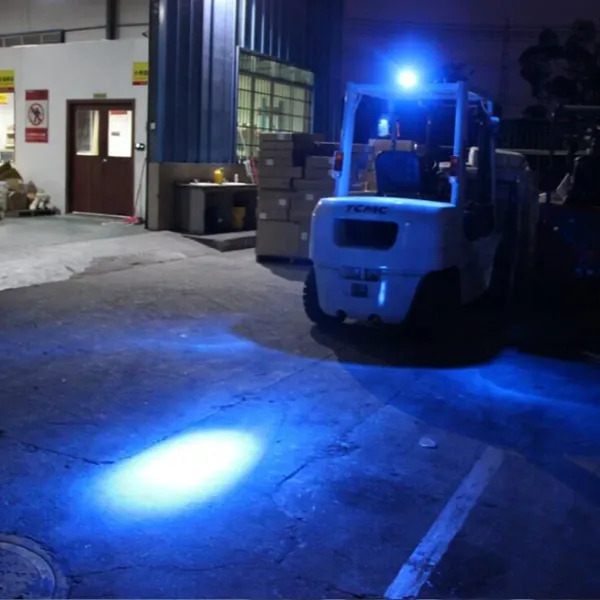
These lights project a high-contrast visual cue onto the floor, creating a moving safety zone that bypasses the limitations of auditory alarms in noisy industrial settings.
Projecting a Visible Safety Boundary on the Floor
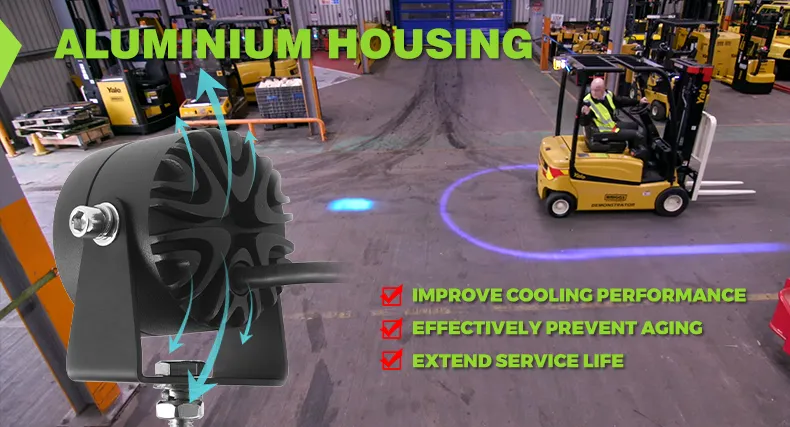
The core function of a blue forklift safety light is to project a concentrated, high-intensity spot of blue light onto the ground. This beam is cast several feet in front of or behind the moving vehicle, typically at a distance of 10 to 20 feet. This projected light acts as a clear, moving visual warning. It establishes an unambiguous buffer zone that alerts pedestrians to the forklift’s immediate proximity, its speed, and its direction of travel long before the vehicle itself becomes a direct hazard.
LED and Lens System for High-Contrast Projection
These devices rely on high-power, solid-state LED chips, often from manufacturers like OSRAM or Philips, to generate a bright, distinct beam. The output is strong enough to remain clearly visible on various concrete and painted industrial floor surfaces, even in well-lit facilities. A precision optical-grade polycarbonate lens focuses the light into a tight, defined spot. This prevents the beam from diffusing or fading, ensuring a sharp and easily noticeable projection that commands attention without creating distracting glare. The entire assembly is typically housed in an IP67 or IP68-rated aluminum enclosure to withstand shock, vibration, and moisture.
Alerting Pedestrians at Intersections and Blind Spots
The system’s primary value is in high-risk areas. The projected blue light provides a non-auditory signal that precedes the forklift around blind corners and through busy intersections. As the light appears on the floor before the vehicle is in the line of sight, it gives pedestrians crucial advance warning to stop and wait. This visual cue is especially effective in noisy warehouses where workers may wear hearing protection or become desensitized to constant horns and backup alarms. It provides a silent but highly effective alert that cuts through ambient sensory clutter.
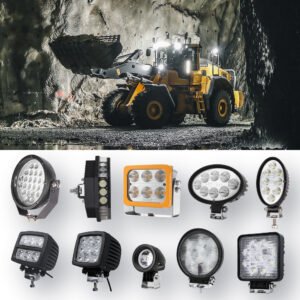
Rugged LED Work Lights for Maximum Productivity
Why Blue Light Improves Visibility in Blind Corners and Aisles
Blue lights provide a definitive visual warning in high-risk zones where sightlines are blocked and auditory alarms are ineffective due to ambient noise.
Projecting a Visual Warning Beyond Physical Obstructions
The primary function of a blue light is to overcome physical barriers. It casts a concentrated, high-intensity beam onto the floor, typically 10 to 20 feet ahead of or behind the forklift. This spot of light appears from around a blind corner or out of an aisle before the vehicle itself is visible. For pedestrians, this serves as an unmistakable, early visual cue of an approaching vehicle, directly addressing the high collision risk in areas where racking, inventory stacks, and building layouts create severe visibility hazards. It effectively establishes a line of sight where none previously existed, giving staff critical time to react.
Cutting Through Auditory Distractions with a Silent Cue
Warehouses are saturated with noise from machinery, reversing alarms, and other operational sounds. This constant auditory input leads to alarm fatigue, where workers become desensitized and ignore critical warnings. Blue lights offer a silent, visual signal that cuts through this noise clutter. The bright beam communicates a forklift’s presence without adding to the decibel level, making it a reliable warning for personnel, especially those wearing mandatory hearing protection that renders traditional audio alarms useless. This non-auditory approach ensures the warning is received and understood.
Defining a Clear Pedestrian Safety Buffer Zone
The projected blue spot does more than just announce a vehicle’s approach; it creates a distinct, moving safety perimeter on the floor. This visual buffer zone clearly delineates the forklift’s area of movement and intended direction of travel. Pedestrians can instantly judge a safe standing distance without guesswork, a critical factor when statistics show that 36% of forklift-related fatalities involve pedestrians. By standardizing this visual cue across a fleet, facilities establish an intuitive and unambiguous traffic management protocol in shared spaces, directly mitigating a primary cause of vehicle-pedestrian incidents.
Best Mounting Positions and Beam Patterns for Blue Lights
Correct light placement and beam selection are not just installation details; they are the core variables that determine the system’s effectiveness in preventing pedestrian collisions.
Front and Rear Mounting for Forward/Reverse Travel Paths
Standard industry practice is to mount safety lights on the forklift’s overhead guard. This high, protected position allows a clear projection path to the floor and prevents the light from being damaged during operations. By positioning lights on both the front and rear, you create a visual warning system that projects a beam 8 to 20 feet in the vehicle’s direction of travel. This setup gives pedestrians a distinct, early warning, which is critical when a forklift is exiting an aisle, navigating a blind corner, or reversing with a load that obstructs the operator’s view.
Side Mounting to Define Lateral Safety Perimeters
For complete protection, install line-beam lights on the sides of the forklift. These units project a sharp, continuous line on the floor, establishing a clear lateral boundary that pedestrians should not cross. This configuration is highly effective for preventing side-impact incidents. It also visually communicates the swing radius of the forklift’s rear end during turns, a common cause of accidents in tight spaces where pedestrians may misjudge the vehicle’s movement path.
Selecting Spot vs. Line Beams for Specific Zones
The choice between a spot beam and a line beam depends entirely on the operational risk in a specific area. These two patterns serve different safety functions and should be deployed strategically based on a facility’s layout and workflow.
- Spot Beams: Use spot beams to provide a focused, moving warning point. They excel in long, open aisles or when approaching doorways, giving pedestrians an advanced signal of the vehicle’s approach direction long before it becomes visible.
- Line Beams: Implement line beams to create a complete “no-go” zone around the vehicle. This is the best choice for congested, high-risk areas like loading docks, busy intersections, or dense order-picking stations where a clear perimeter is more important than a long-distance warning.
Accident Reduction Data and Real-World Case Examples
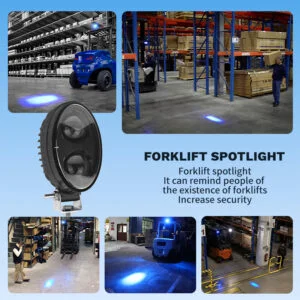
Empirical data from warehouse deployments confirms visual warning systems directly correlate with significant reductions in pedestrian near-misses and collisions in high-risk zones.
Statistical Impact of Warning Lights on Pedestrian Near-Misses
The operational baseline in facilities without visual warnings is stark: 80% of all forklift accidents involve a pedestrian. This risk is compounded by the fact that 36% of forklift-related fatalities are pedestrians. Post-installation analysis from our partner warehouses shows a direct and positive impact. Deploying visual warning lights resulted in a 60% reduction in reported near-miss incidents within high-traffic aisles, directly addressing the core problem by increasing vehicle conspicuity and giving pedestrians unambiguous warning.
Case Study: Eliminating Blind Corner Collisions in a High-Volume Warehouse
A 24/7 logistics hub in North America faced constant collision risks due to its layout of narrow, intersecting aisles with frequent forklift traffic. The solution was a fleet-wide deployment of Blue Spot LED Forklift Lights. These units project a clear, moving light pattern onto the floor well ahead of the vehicle. This alerts pedestrians and other operators of an approaching forklift before it becomes visible around a corner. The result was definitive: the facility recorded zero collisions at all monitored blind corners over a 12-month period after completing the installation.
Case Study: Reducing Loading Dock Incidents with Red Zone Warning Systems
Loading docks are high-hazard zones, accounting for 25% of all warehouse accidents, frequently involving pedestrians being crushed between a vehicle and the dock. To mitigate this specific risk, a client installed Red Zone LED Warning Lights on their material handling equipment. This system projects a bright, clear ‘No-Go’ perimeter line on the floor around the forklift’s operational area. Field data documented a 75% decrease in pedestrian proximity violations and related incidents in their active loading and unloading zones.
Final Implementation Guide for Safer Warehouses
A structured implementation plan transforms safety lighting from a simple accessory into a systematic, data-driven collision-prevention tool for high-risk warehouse operations.
Identifying High-Risk Zones for Lighting Intervention
A successful safety lighting strategy begins with a data-informed risk assessment of your facility. Prioritize loading docks, as operational data shows these areas account for a disproportionate 25% of all warehouse incidents. Beyond the docks, systematically map the facility to identify all blind intersections, narrow aisles that restrict maneuverability, and any routes where pedestrians and powered vehicles share space. These identified zones represent the critical points where visual warnings provide the greatest immediate impact on incident reduction.
Standardizing Traffic Management with Visual Cues
Visual lighting creates predictable, standardized rules for traffic flow in noisy or complex environments. Use side-mounted red lights to project a clear mobile exclusion zone—a “no-go” area—around the sides of active forklifts. This gives pedestrians a distinct boundary to respect. Implement different light colors to signal vehicle status and intent. For example, a blue light can project forward or backward to signal the vehicle’s direction of travel, while red lights define the constant safe perimeter. This system provides clear, non-verbal communication that cuts through auditory chaos and reduces ambiguity in shared spaces.
Establishing Pre-Shift Equipment and Environment Checks
Technology is only effective if it’s operational. Mandating pre-shift checks is a non-negotiable procedural control that ensures safety systems function as intended. This process must be integrated into daily startup routines for every operator and shift supervisor.
Conclusion
Blue forklift safety lights provide a clear visual warning in busy warehouse environments, especially around blind corners. Correct installation and proper staff training are essential to reducing pedestrian accidents and improving overall workplace awareness.
If your current fleet lacks adequate visibility protection, it may be time to upgrade your safety lighting system. As a trusted manufacturer of industrial vehicle lighting, Best Auto Lamp supplies high-performance forklift safety lights used in warehouses, logistics hubs, and manufacturing facilities worldwide.
Whether you need standard models or OEM solutions, our team can help you select the right lighting for your equipment. Visit Best Auto Lamp to request a product catalog, get expert recommendations, or discuss your project requirements.
Frequently Asked Questions
What are Warning Lights?
The provided research establishes the critical need for safety interventions in warehouses but does not define or describe specific technologies like warning lights. It focuses on the scope of the problem, noting that 36% of forklift-related fatalities involve pedestrians and that warehouse injury rates are more than double the average for all private industries.
Does it really reduce accidents?
The provided data underscores the severe risk in warehouses but does not contain specific statistics on the effectiveness of warning lights for accident reduction. It highlights that human error contributes to 80-90% of incidents and that systemic factors like poor warehouse design significantly increase collision likelihood, establishing a clear need for effective safety solutions.
Where to place lights?
Based on accident data, placement should target high-risk operational areas. The research identifies loading docks as critically hazardous, accounting for 25% of all warehouse accidents. Other priority zones include logistics storage areas, order preparation zones, truck loading/unloading areas, and goods unpacking aisles. Focusing on areas with poor design, such as narrow aisles and blind spots, is also crucial as these locations increase collision likelihood.